


On the battlefield of tomorrow, infrared sensing will be a critical layer for detecting, identifying, and tracking threats when operations become smaller, faster, more distributed, and more time-sensitive. By supporting day-night imaging, thermal contrast, launch warning, target confirmation, and multi-sensor situational awareness, SWIR, MWIR, and LWIR infrared detectors help soldiers, UAVs, autonomous platforms, and defense systems operate with greater speed and resilience — even when visibility, connectivity, or navigation are contested.
The battlefield is already changing, and it is changing fast. Operations are becoming more connected, more distributed, and more time-sensitive. Networks, sensors, and decision-speed are starting to matter as much as the platforms themselves.
Power will no longer be measured by who fields the biggest tank or the fastest jet. It will be measured by who can connect shooters and decision-makers across every domain: land, sea, air, space, and cyber. Survivability will belong to forces that stay agile and resilient as decision timelines compress from minutes to seconds.
The shift is already visible. Drone swarms stretching defenses. Commercial satellites enabling more frequent coverage of the battlespace. Electronic warfare turning the electromagnetic spectrum into a constant contest. Each of these signals point in the same direction: future conflict will be shaped by speed, adaptability, and the ability to sense what matters most.
At SCD, we track how the battlefield is taking shape, and we align our technology roadmap to support the systems our partners are building for that reality.
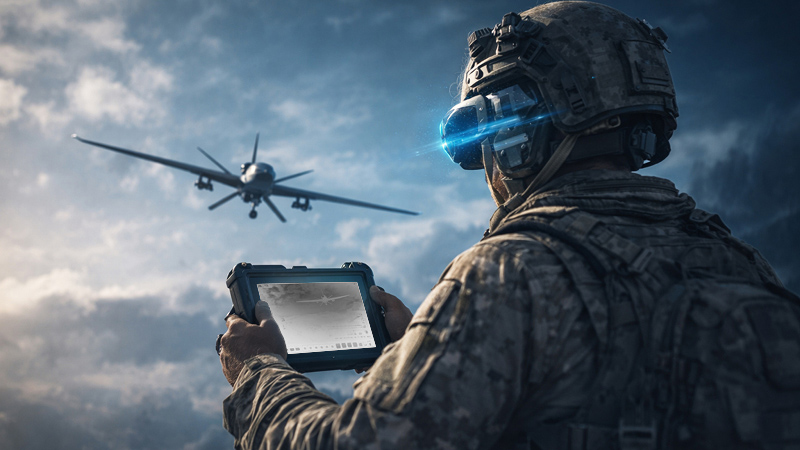
New threats and new concepts of operation are pushing systems to get smaller, lighter, and more cost-effective. As platforms move toward compact UAVs, loitering munitions, and soldier-carried systems, sensors have to keep up, delivering performance within tighter size, weight, power, and cost limits.
This shift brings two advantages. First, it enables scale. Instead of a handful of premium platforms, commanders can field dozens or even hundreds of smaller, more affordable assets. Second, it creates persistence. Small UAVs and unattended ground sensors can stay forward, watching continuously and feeding data into the network with far lower cost per mission.
Infrared technology is central to this trend. As detectors shrink in size, weight, and power while improving in performance, thermal sensing across multiple IR bands is no longer confined to high-end platforms. Today it rides on expendable drones, compact payloads, loitering munitions and soldier optics, extending coverage and confidence across the force.
Precision strike and persistent sensing are also putting logistics in the crosshairs. Massed depots, static convoys, and predictable resupply routes are all vulnerable. Survivability depends on distribution, deception, and mobility.
Infrared helps by providing persistent monitoring of supply routes, convoy movement, and forward logistics activity. With multispectral sensing on UAVs, vehicles, and unattended systems, commanders gain early warning and situational awareness to keep logistics moving under threat.
As electronic warfare intensifies, systems cannot assume clean comms, clean GPS, or uninterrupted links. The ability to detect, confirm, and track in degraded conditions becomes a survivability requirement, not a nice-to-have.
Infrared sensing strengthens resilience by providing a complementary channel for day and night detection and identification, supporting operational effectiveness when other inputs are denied, disrupted, or degraded. This helps maintain situational awareness and target confirmation even when connectivity and navigation are contested
These trends point to one clear conclusion: the battlefield of tomorrow will be smaller, faster, more connected, and more contested than ever before.
For program managers, this means balancing exquisite systems with scalable, expendable ones. For system architects, it means designing multispectral payloads that can operate under jamming and fuse data across bands across domains.
For procurement leaders, it means evaluating lifecycle costs, and upgrade cadence as closely as purchase price.
For defense OEMs and system integrators, this means preparing for sensor-centric warfare, where survivability depends on networks that endure under pressure with mission-critical EO/IR at the core.
At SCD, we see these shifts taking shape every day. Our detectors already cover SWIR, MWIR, and LWIR, enabling sensing across drones, seekers, soldier systems, and space-based layers. With full vertical integration, we deliver the supply assurance, program certainty, and mission-ready performance that defense partners depend on.
The battlefield of tomorrow is not a distant vision. It is already emerging. The question is who will adapt, connect, and act at the pace the future fight demands.
SCD. Always by Your Side. Always What You Need. Always a Step Ahead.
What is the battlefield of tomorrow?
The battlefield of tomorrow refers to a more connected, distributed, and time-sensitive operating environment where soldiers, UAVs, autonomous platforms, sensors, and command systems must exchange information faster and operate under more contested conditions.
Why is infrared sensing important for the future battlefield?
Infrared sensing is important because it helps defense systems detect, identify, and track targets beyond visible-light conditions. It supports day-night operation, thermal contrast, situational awareness, launch warning, and target confirmation when speed and visibility are critical.
How does miniaturization affect defense sensing systems?
Miniaturization allows infrared sensors and EO/IR payloads to be integrated into smaller platforms such as UAVs, soldier systems, compact vehicles, and distributed sensor nodes. This helps forces scale sensing coverage without relying only on large, high-cost platforms.
How do SWIR, MWIR, and LWIR sensors support modern battlefield operations?
SWIR, MWIR, and LWIR sensors support different sensing needs across the battlefield. SWIR can support reflected-light imaging and certain laser-related use cases, MWIR is widely used for cooled thermal imaging and long-range detection, and LWIR supports thermal imaging in many uncooled or lower-SWaP applications.
Why does infrared sensing matter in contested or jammed environments?
Infrared sensing provides a complementary detection layer when communications, GPS, radar, or other inputs may be degraded or unavailable. It helps maintain situational awareness and target confirmation even when the electromagnetic spectrum is contested.
How can infrared sensing support UAVs and autonomous platforms?
Infrared sensing can help UAVs and autonomous platforms detect objects, monitor movement, support navigation context, and cue other sensors. Compact IR detectors are especially relevant where size, weight, power, and bandwidth are limited.
What role does thermal imaging play in battlefield logistics?
Thermal imaging can support monitoring of routes, vehicles, supply movements, and operational areas under low-light or degraded visibility conditions. This helps improve awareness around logistics activity without depending only on visible-light cameras.
How should defense OEMs prepare for future EO/IR system requirements?
Defense OEMs should plan for EO/IR systems that are compact, multi-spectral, lower-SWaP, and easier to integrate into distributed platforms. Future-ready systems should support sensor fusion, faster detection workflows, and resilient operation in complex environments.


