


The character of warfare is undergoing a dramatic evolution. Conflicts are shifting towards a hyper-connected, sensor-saturated battlespace where information dominance is as critical as firepower. Ubiquitous sensing, autonomous systems, and AI-driven decision loops are compressing the time from detection to action, creating what some strategists call a “kill web” of networked forces. In this new environment, the ability to see without being seen – to detect the adversary’s signature while minimizing one’s own – will largely define survivability and success. Electro-optical/infrared (EO/IR) technologies, especially advanced infrared sensing across short-wave, mid-wave, and long-wave bands (SWIR, MWIR, LWIR), are emerging as pivotal enablers of tactical and strategic advantage on this future battlefield.
8 Min Read | by Ganit Shter Bar Joshua
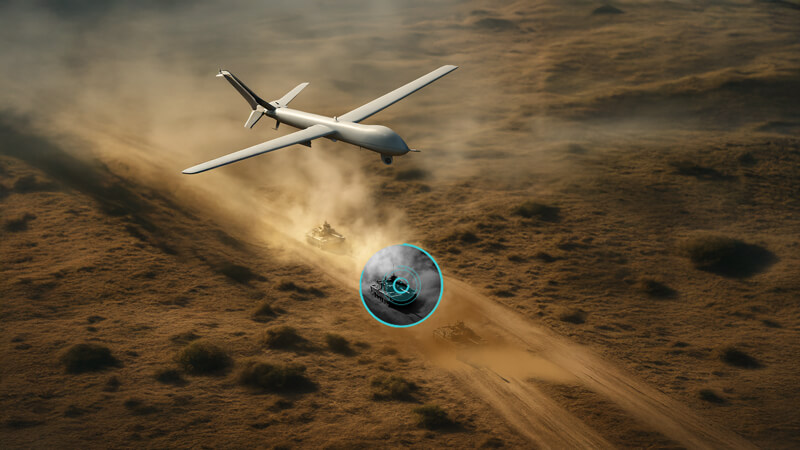
Several technology trends are converging to shape tomorrow’s battlespace. Miniaturization of sensors and electronics means that advanced capabilities are no longer limited to large platforms – even small drones, robots, or soldier-borne devices can carry thermal cameras or multispectral sensors. This feeds into the Internet of Battlefield Things (IoBT), a military adaptation of IoT where myriad devices (UAVs, UGVs, smart munitions, wearables) are interconnected and continuously sharing data. Swarms of autonomous drones exemplify this trend: networked together, they can collaboratively scout, monitor, or strike targets without constant human control. Equally important is the integration of artificial intelligence (AI) at the tactical edge, significantly decreasing information overload, enabling a quicker and more intelligent decision-making process without requiring the processing of huge amounts of information.
The flip side of ubiquitous sensors is that hiding on the battlefield has become extraordinarily difficult. Modern militaries are painfully learning that any detectable signature – be it radio emissions, heat, noise, or even a digital footprint – can draw deadly attention. Infrared sensors are particularly adept at detecting heat signatures, making concealment a formidable challenge. This is why signature management – reducing one’s visibility across the electromagnetic and thermal spectrum – is now regarded as a critical survival skill in future wars.
Infrared technology, spanning the SWIR, MWIR, and LWIR bands, will be a linchpin of situational awareness in the future fight. Unlike the human eye or standard cameras, IR sensors detect thermal radiation, enabling vision in darkness and through obscurants. Each band brings unique strengths: MWIR excels at detecting hot exhausts and missile launches, SWIR penetrates haze and detects lasers, and LWIR offers wide-area thermal awareness, especially in humid or dusty environments. The trend is toward multi-band sensor fusion – combining SWIR, MWIR, LWIR, and visible feeds – to create a comprehensive, resilient picture of the battlefield.
SCD (SemiConductor Devices) stands as a global leader in infrared sensing technology, uniquely positioned to help military and security forces navigate the future battlefield. With nearly five decades of experience, SCD develops detectors across the full IR spectrum – SWIR, MWIR, and LWIR – both cooled and uncooled. Its vertically integrated approach, from materials growth to final packaging, ensures performance, reliability, and mission-tailored solutions. SCD’s detectors are field-proven and embedded in critical systems worldwide, supporting air, land, sea, and space applications. By co-developing with partners and anticipating emerging threats, SCD ensures its technologies remain at the cutting edge, providing forces with the clarity to see first, act first, and survive in tomorrow’s battlespace.


