


Modern conflict is not just faster. It is made of very short moments, then long gaps. The signals that matter often show up as short, messy changes inside clutter: a brief flare, a sudden movement, a momentary glint, a rapid transition from “nothing here” to “something just happened.” If your sensing stack is built only around full-frame video, you can still miss the moment, or you can detect it too late to matter.
That is where event-based sensing enters the picture.
6 Min Read | by Ganit Shter Bar Joshua
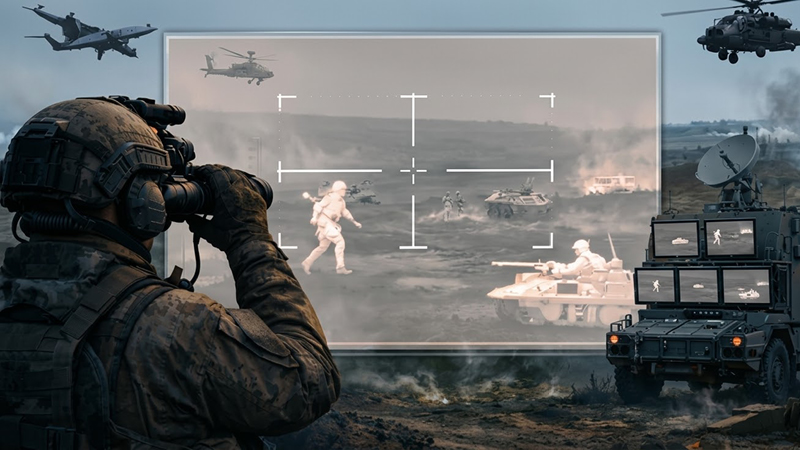
Traditional EO/IR imagers do a simple thing very well: they sample the world in frames. You get a full image, at a fixed rate, whether anything changed or not.
Event imaging flips the rules.
Instead of streaming every pixel, every frame, all the time, an event-based sensor is designed to focus on change. It outputs sparse, time-tagged information when something in the scene crosses a defined threshold. In other words, it is sometimes less “video” and more “change telemetry.”
That shift is a different way to build a rapid alert layer, especially when platforms are smaller, bandwidth is limited, and decision windows compress hard.
Yes, muzzle flash detection and launch warning are part of the story. These are classic examples of rapid transients, and event-based sensing is naturally aligned with that kind of problem.
But the useful value is broader than “hot events.” In real operational scenes, “important change” can be:
Event imaging can be used as cueing, but it is not limited to that mode. In some missions, the ability to reliably “fish out” ultra-short events is the point.
This ties directly into the “smaller, faster, more connected” battlefield trend.
Event-based sensing supports that direction because it can reduce data volume by design and move detection earlier in the chain.
A lot of momentum in event imaging started outside defense, largely with visible-spectrum event cameras. Automotive and robotics pushed the idea because it is useful anywhere you have fast motion, hard lighting, and a need for low latency.
Defense does not copy-paste civilian tech. It adapts it.
The battlefield demands:
So, the opportunity is not “let’s use a neat camera concept.” The opportunity is: bring event-based thinking into mission-aligned electro-optics in a way that actually survives reality.
SWIR often sits in an interesting middle ground. It supports reflected-light and laser-related use cases, so it is a good fit for catching change events that do not present as thermal cues. That matters because many “critical moments” are not thermal at all. Depending on the scene and mode of operation, meaningful change can show up as reflected intensity shifts, brief specular behavior, or sudden illumination and contrast transitions. An event-driven approach can flag those changes quickly and let the system respond.
SWIFT-EI (Event Imager) is a practical example of event-based sensing moving from concept into detector roadmaps.
The point is not to replace conventional imaging. The point is to add a fast change-detection channel into the broader EO stack, while standard imaging continues in parallel, without losing frames.
Event-based performance isn’t just about detector material. It lives in the chain: target and threat behavior, readout behavior, processing logic, packaging, and test discipline.
If you want event-based sensing to be reliable, not chatty, not fragile, not a false-alarm machine, you need control over how the detector is designed, built, and validated. That is what makes it feasible to move from concept to fieldable capability. And crucially, it can run in parallel to standard imaging, so you keep your full frames. You’re adding an event channel, not trading video away.
This is where event imaging turns from “interesting” to “useful”:
1. Run it beside standard imaging, not instead of it.
Use event imaging as a change-detection layer and, in some cases, as a classification aid. Keep conventional imaging for identification, situational awareness, and human decision points.
2. Design the workflow around “detect, then confirm.”
Let event data trigger the first alert, then confirm using another sensing mode and mission-specific algorithms. Sometimes that confirmation is EO/IR imaging. Sometimes it is radar, RF, or navigation context.
3. Treat data volume as a design parameter, not a bonus.
Event-based sensing can dramatically reduce bandwidth and compute load, but only if the system is designed to ingest, fuse, and act on event streams effectively.
4. Engineer false-alarm behavior from day one.
A fast alert that is wrong is not “early warning.” It is high-rate noise. Thresholds, filtering, correlation logic, and mission context need to be part of the architecture, not an afterthought.
5. Fuse it into multi-sensor logic.
Event imaging gets more valuable when correlated with other cues (EO, IR, radar, RF, navigation context) to raise confidence and reduce ambiguity.
The battlefield is full of signals. The advantage belongs to systems that recognize the right change first, then act on it with confidence.
That is what event-based infrared sensing is really about: detecting critical moments early enough to matter, while keeping the rest of the system focused, efficient, and ready.
SCD. Always by Your Side. Always What You Need. Always a Step Ahead.
What is event-based infrared imaging in EO/IR systems?
Event-based infrared imaging is a sensing approach that focuses on meaningful change instead of continuously outputting full video frames. In EO/IR systems, it acts as a fast change-detection layer that can highlight critical events earlier and more efficiently.
How is event-based infrared imaging different from traditional EO/IR imaging?
Traditional EO/IR imaging captures full frames at a fixed rate, whether the scene changes or not. Event-based infrared imaging reports what changed, which can reduce unnecessary data flow and improve response time in fast, cluttered environments.
Why is event-based infrared detection important for battlefield sensing?
Battlefield sensing often depends on detecting short-lived, hard-to-capture changes in complex scenes. Event-based infrared detection helps systems respond faster to critical moments while supporting lower latency, earlier alerts, and more efficient decision-making.
What can event-based infrared sensors detect besides muzzle flash?
Event-based infrared sensors can help detect sudden intensity shifts, fast-moving objects, brief laser-related signals, and short-duration changes that may be diluted in standard frame-based imaging. This makes them relevant for more than launch warning alone.
Why is SWIR a strong starting point for event-based infrared imaging?
SWIR is a strong starting point because many meaningful scene changes are not purely thermal. In SWIR imaging, reflected-light variation, specular effects, contrast changes, and laser-related cues can all support faster event-driven detection.
Can event-based infrared imaging replace conventional infrared detectors or cameras?
No. Event-based infrared imaging is most effective when used alongside conventional infrared detectors or cameras, not instead of them. It adds a rapid detection channel, while conventional imaging still supports identification, situational awareness, and visual confirmation.
How should system architects integrate event-based infrared sensors into multi-sensor EO/IR systems?
System architects should use event-based infrared sensors as part of a detect-then-confirm workflow. In multi-sensor EO/IR systems, event data can provide the first alert, while other sensing layers such as conventional EO/IR imaging, radar, RF, or navigation context help confirm and classify the event.
How does event-based infrared imaging improve multi-sensor defense systems?
Event-based infrared imaging improves multi-sensor defense systems by adding earlier change detection, lower data burden, and better cueing for other sensors. When fused with EO, IR, radar, and RF inputs, it can help increase confidence, reduce ambiguity, and support faster operational response.


